
One of the most memorable trades I have made was a long position in Unity. During January 2026, Google's Project Genie demo sent gaming stocks, which I started accumulating heavily, into a free fall, and I eventually sold at $40 with around 50% profit just a couple months later. I have probably played more games than you have eaten grains of rice. To me, Unity had recognised a market distorted by institutional investors’ fixation on AI: the conviction that it would make traditional game development teams obsolete, and that players would happily accept the results. That prediction was right in the long run, but the market was pricing in a future that had yet to arrive. Hence, my position was rewarded.
I had seen technological enthusiasm collide with player priorities before. STALKER 2 abandoned its NFT plans following a player backlash. The Indie Game Awards revoked Clair Obscur: Expedition 33’s Game of the Year and Debut Game awards under its rules against generative AI, even though the studio described its use as limited to temporary placeholder textures. Players know what they enjoy, and many trust fellow players’ reviews more than critics’ verdicts. They can lift overlooked games into the spotlight and leave heavily promoted disappointments behind. Even relentless marketing cannot guarantee their approval.
However, what is waiting will eventually come, and somewhere in the future, AI will become as commonplace in game production as pesticides in agriculture. Recent booms of 'AI generated shorts', and wide spread production of high quality content such as the 'pengumin' also demonstrated the very shift. A purely 'organic' human made game will eventually be a luxury, but no one knows how to quantitatively describe when or under what conditions this transition will happen.
Hence, I present an quantitative analysis concerns AI-assisted art and asset production in gacha games and fixed price games. We hold production output, quality, release timing and other operating costs fixed.
Method
We describe the financial decision using two quantities:
Net saving fraction, b: production expenditure avoided, minus the costs of AI tools, transition, review and rework, divided by baseline player revenue.
Lost revenue fraction, L: revenue lost because of AI adoption, divided by that same baseline revenue.
Both cover the next twelve months. Baseline revenue is what the company would otherwise receive after refunds, transaction taxes and platform/payment fees. Therefore:
Change in profit / baseline revenue = b − L.
We construct 41 populations of 10,000 paying players, holding mean spending and total revenue constant across populations to isolate the effect of how spending is distributed. Relative variance (variance divided by mean spending squared) ranges from 0.01 to 5,000, while skewness ranges from 1 to 90. Relative variance measures how widely spending differs between players; positive skewness describes the asymmetry towards exceptionally large spending amounts. We vary relative variance at each fixed skewness, then compare populations with different skewness at matched relative variance. An equal-spending benchmark represents future purchases of an idealised fixed-price game, where every buyer pays the same amount. Low-variance populations approximate this even distribution, with players contributing similar amounts. By contrast, populations with high variance and strong positive skewness represent games whose revenue depends heavily on a small minority of exceptionally large spenders, or “whales,” alongside many players who spend much less.
We assume each player independently stops all future purchases with probability p, regardless of their spending. Everyone else continues unchanged, with no replacement revenue. The expected lost revenue fraction is consequently p in every population.
We require both a non-negative expected profit change and at least a 95% chance that savings cover lost revenue:
Adopt when b ≥ max[p, Q95(L)].
We choose a 95% protection requirement meaning savings must cover lost revenue in at least 95% of possible outcomes. (Q_{95}(L)) is the minimum saving fraction needed to meet that requirement.
To estimate it, we consider every possible combination of the twelve largest spenders continuing or stopping their purchases, weighted by its probability. We simulate the remaining players individually through repeated random trials. This ensures that rare departures by major spenders are included.
Results
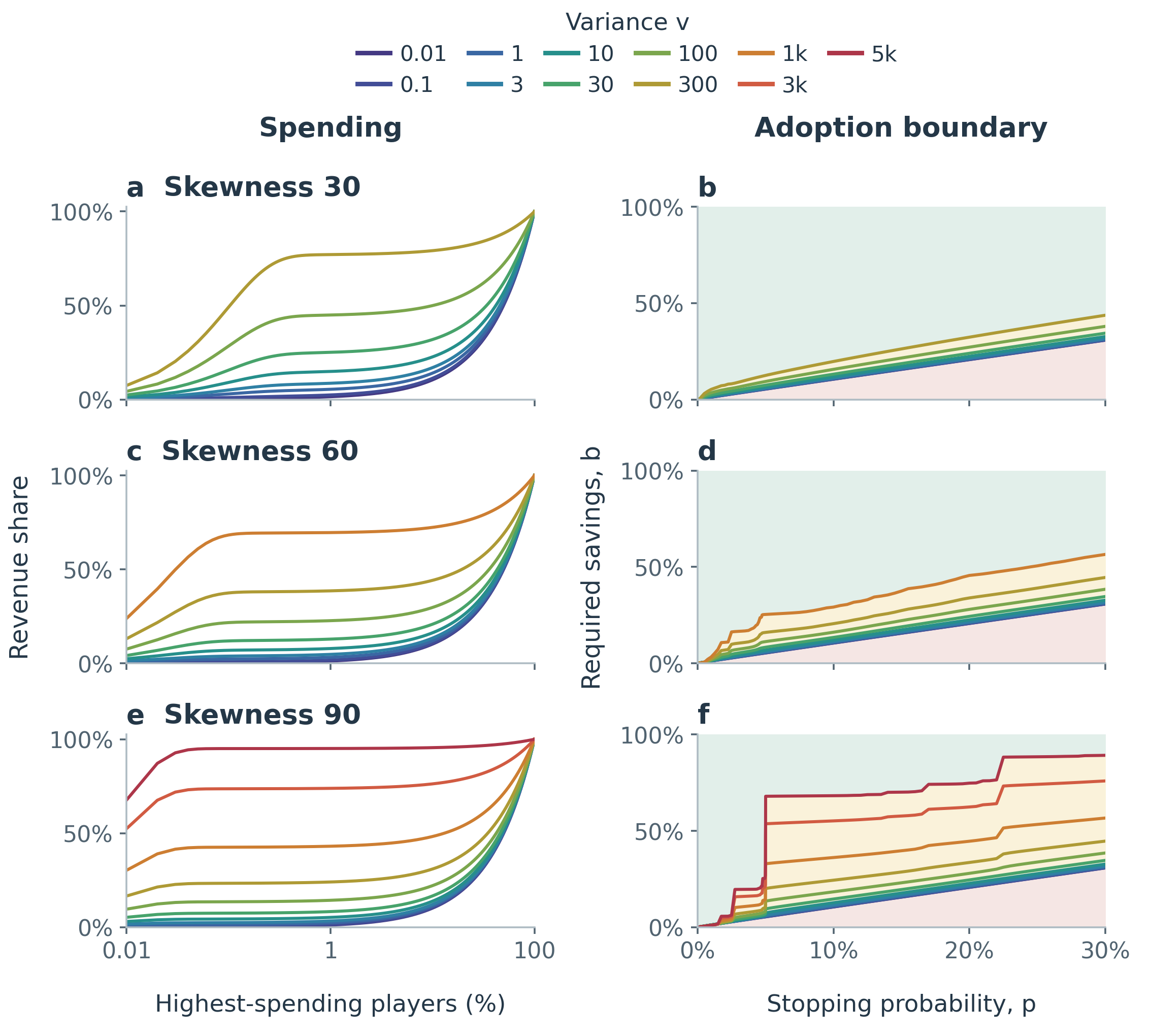
Greater spending variance generally pushes the adoption boundary upwards, meaning AI must deliver larger net production savings to compensate for the risk of losing important spenders. As variance falls, the curves converge towards the equal-spending baseline, where revenue is spread across many small contributions and losses are more predictable. This baseline rises with the stopping probability (p), with only a small risk buffer above expected revenue loss.
The separation becomes particularly large when high variance is combined with strong right-skewness. A single spender can then account for a substantial share of receipts, making their departure financially consequential. At a 10% stopping probability, the most extreme population requires savings of approximately 68.3% of revenue, compared with 10.5% for the equal-spending benchmark. Such dependence on whales can make AI adoption financially demanding even when most players continue purchasing.
The sharp rise near a 5% stopping probability follows directly from the chosen 95% protection requirement. In the most extreme population, one player supplies 67.7% of revenue. Savings below that share cannot cover any outcome in which this player stops. Once (p) exceeds 5%, leaving that loss uncovered would mean failing in more than 5% of outcomes. The required saving must therefore reach at least that player’s revenue share. Below 5%, the event may fit within the tolerated tail, allowing a lower threshold, although other losses still matter. The jump comes from the risk criterion; expected revenue loss remains (p) and changes smoothly.
Some boundaries also cross, especially at low stopping probabilities. A population with rarer but larger losses can require less protection while those losses remain sufficiently unlikely, then substantially more as departures become likelier. These crossings are secondary, model-specific features of the spending distributions and percentile rule.
Conclusion
The adoption decision depends on how revenue is distributed, how much AI saves, and how players respond to its use and disclosure. These quantities determine where a game sits relative to its adoption boundary. However, I would not trust this simple model alone to guide a major gacha studio’s decision.
The central missing ingredient is collective behaviour. Our model assigns each player an independent chance of stopping purchases. A more realistic model should allow rumours, creator coverage and community reactions to influence other players, potentially turning isolated dissatisfaction into coordinated spending cuts. In that setting, a studio faces both the loss of individual whales and the possibility of a wider backlash.
Audience research also needs care. A public survey about AI-generated artwork could itself signal that adoption is being considered and provoke the reaction it seeks to measure, particularly during an existing controversy. Surveys, announcements and disclosure should therefore enter the analysis as events that may change player behaviour.
A useful extension would model how backlash spreads through player communities and the wider online audience, how different spending groups respond, and how spending recovers—or fails to recover—over time. It would need calibration against actual spending records and historical controversies, followed by testing on events it was not fitted to. Greater complexity alone would not make its predictions trustworthy.
For billion-dollar businesses, the present diagrams offer a starting framework for identifying risks and testing scenarios. A credible commercial forecast would require evidence about the particular audience, correlated reactions and the consequences of getting the decision wrong.
Glory to Hypergryph for inspiring this research.
Peter Wan is a first-year PhD student at the University of Edinburgh. He previously studied at Cambridge. He publishes biweekly, focusing on finance, investing, and global markets.